Fire Training Sat 29th March

Fire Training Sat 29th March

Fire Training, Sat 29th March

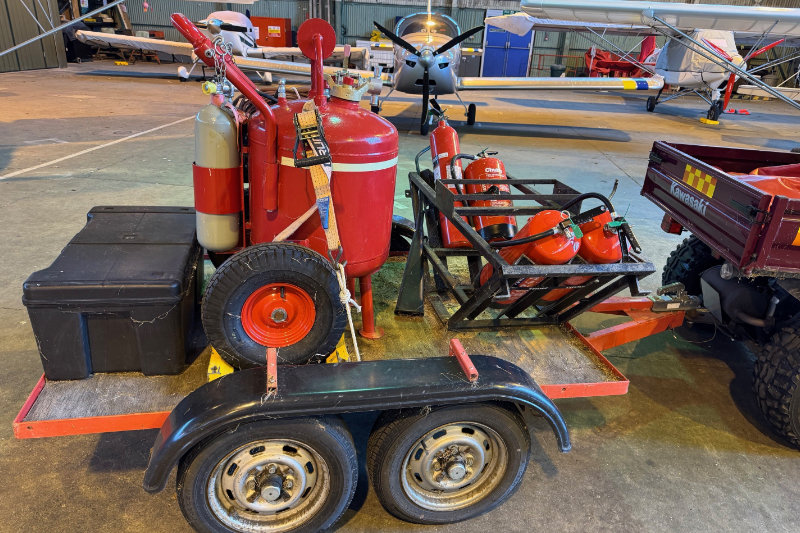
A 90litre fire extinguisher is fitted to the Fire Buggy and stand alone examples are located on the fuelling apron. These are shortly to be replaced by a new 100 litre model.

A training session has been arranged by the Station for Saturday 29th March starting at 0900 at the airfield and all HAC members who are available are strongly urged to attend. Training is likely to last about one hour.

Remember, training in the use of the airfield fire equipment is good airmanship and you should be confident in its use; it might be the key factor in your saving a fellow club member in the event of an on-airfield accident, or in their saving you!

No advance booking required. Just turn up on the day. I will take stock of the number of members who do not attend and see if we need to make additional training available in due course, but please make every effort to attend on 29th.

Mike Russell
Ops Mgr

Ensuring Flight Safety: Learning to Fly at Halton Aero Club

Ensuring Flight Safety: Learning to Fly at Halton Aero Club

Author: M Dilshan Basnayake

Aviation safety is at the heart of every flight operation, and for those learning to fly, understanding the best safety practices is essential. Halton Aero Club, based at RAF Halton in Buckinghamshire, is a premier flying club that offers top-tier flight training and an engaging community for aviation enthusiasts. As a recognised flight training centre, Halton Aero Club follows the latest UK Civil Aviation Authority (CAA) guidelines to ensure all members fly safely and confidently.

Why Choose Halton Aero Club?

 Halton Aero Club is one of the UK’s longest-established flying clubs, offering expert training, a friendly aviation community, and access to one of the best-maintained airfields and aircrafts in the country. Whether you are a beginner taking your first flying lesson or an experienced pilot looking to refine your skills, Halton provides an exceptional environment to learn and grow.

Understanding Aviation Safety and Accidents

Aviation accidents, while rare, can occur due to pilot misjudgement, technical malfunctions, or environmental factors. In the UK, the Air Accidents Investigation Branch (AAIB) and the CAA work together to analyse incidents and introduce new safety measures. As part of Halton Aero Club’s commitment to safety, we ensure that all our pilots and trainees are up to date with the latest regulations and best practices.

Recent reports from the CAA (2024) highlight key safety concerns, such as carbon monoxide (CO) poisoning in piston-engine aircraft, leading to the introduction of a new mandate requiring active CO detectors in these planes. Halton Aero Club is fully aligned with these safety updates, ensuring our aircraft comply with the highest standards.

Latest UK CAA Safety Regulations

 1. Mandatory Carbon Monoxide Detectors

 CO poisoning has been linked to several fatal accidents in general aviation. In response, the UK CAA has made CO detectors compulsory in certain aircraft categories to enhance pilot safety (CAA, 2024). Halton Aero Club has equipped its fleet with the latest CO detection technology to ensure our pilots remain safe.

2. Improved Licensing for General Aviation Pilots

 The CAA is simplifying licensing to make it more accessible for general aviation pilots (CAA, 2024). Halton Aero Club supports this initiative, making it easier for new pilots to obtain their Private Pilot’s Licence (PPL) and progress towards advanced training.

3. Enhanced Airspace Awareness

Recent adjustments to UK airspace regulations, such as the Manchester Low-Level Route, are aimed at improving navigation and reducing collision risks (CAA, 2024). At Halton Aero Club, our instructors provide in-depth training on airspace management and navigation to keep our members flying safely.

Best Practices for Safe Flying at Halton Aero Club

Pilots and trainees at Halton Aero Club are encouraged to follow key safety principles:

  • Pre-Flight Checks: Always conduct thorough inspections of aircraft, fuel levels, and weather conditions before take-off.
  • CO Detector Compliance: All aircraft at Halton are equipped with the latest CO detectors, in line with CAA requirements.
  • Situational Awareness: Stay updated on airspace changes and use navigation tools for improved safety.
  • Ongoing Training: Our instructors offer continuous learning opportunities to enhance flying skills and regulatory knowledge.
  • Risk Management: Conduct risk assessments before every flight to anticipate potential hazards.

Join the Halton Aero Club Community

If you have ever dreamed of taking to the skies, Halton Aero Club is the perfect place to start your aviation journey. Our highly experienced instructors, well-maintained aircraft, and strong focus on safety make us one of the best flying clubs in the UK. Whether you are training for your Private Pilot’s Licence (PPL) or simply looking to enjoy recreational flying, we provide the ideal setting to learn and thrive.

 Discover More and Start Your Flying Adventure Today!

For more information about learning to fly at Halton Aero Club, visit our website: www.haltonaeroclub.co.uk.

Threat and Error Management as You Return to Flying After a Long Layoff – March 2025 Update – KNOW YOUR LIMITS!

Threat and Error Management as You Return to Flying After a Long Layoff – March 2025 Update – KNOW YOUR LIMITS!

Dear Member,

As we return to flying after a poor winter a refresher on TEM might be useful.

The aim is to consider potential threats and errors for your flight and mitigate against them. The earlier you can do this, the better. For example, having a look on Windy/Met Office rainfall radar before you leave on a Nav-ex in order to plan around weather, as opposed to being caught out once you’re airborne. If you think you might miss a set of checks on a nav leg because you will be concentrating on not getting lost, write ‘FREDA’ on your map to remind you.

  • Threats: something you don’t have control over, which risks the safe conduct of your flight.
  • Errors: something you do/don’t do, which wasn’t intended and perhaps against SOPs, which risks the safe conduct of your flight. You are human after all and you will make mistakes.

When there are concurrent ops with gliding and powered flying, how will the gliders affect how you operate? What’s the ‘So what‘?

A good way to start your brief is to ask “What is different about today?” That should help you identify pertinent Threat and Errors. Some people use the acronym WANT: Weather, Aircraft, NOTAMs, Terrain to help them with TEM. Others use PAVE: Pilot, Aircraft, enVironment, External pressures.

The attached guide to TEM goes into a little more detail. Please take the time to have a read.

Also feel free to google the subject. ‘SKYbrary’ a great website; although it’s orientated more to commercial flying it’s still transferable to us: https://www.skybrary.aero/index.php/Threat_and_Error_Management_(TEM)_in_Flight_Operations

Much of the post Covid Return to Flying Guide is also relevant to return to flying after a winter layoff. Link below. 

As  ever, we wish you safe flying. Remember, you make your own luck!

Click on the buttons below to open the attachments. 

HAC FOB Jan 25

HAC FOB Jan 25

HAC FOB Update

The HAC FOB has been updated and went live on 15 January and all pilots will be “in the Red” until they have signed as having read the new FOB.

In addition to minor editorial changes the key updates are:

Order 1.3 Flight Authorisation.

1.3.6 Self Authorization Requirements The minimum hours for Self Auth are now  50 (vice 100).  Also, self auth approval is now to be renewed annually.

Order No. 1.4 Completion of Technical Log and Notification of Defects of HAC Aircraft.

New terminology, buit procedure unchanged

Order No. 1.5 Requirements for Solo Flying in Club Aircraft

1.5.4 Addition of 60 day currency requirement for Self Auth pilots

1.5.6 Addition of read across from C152 to PA28

Order 2.14 Refuelling Procedures

2.14.2  Ac grounding to be to noseleg (not exhaust)

Order No 3.2 Weather Minima

3.2.6  Acknowledgement of possible errors in roof mounted anemometer.

Order No 7.9 Engineering

7.9.7  Easterly Hangar doors not to be used.

Halton Aero Club
Privacy Overview

This website uses cookies so that we can provide you with the best user experience possible. Cookie information is stored in your browser and performs functions such as recognising you when you return to our website and helping our team to understand which sections of the website you find most interesting and useful.

You can review our privacy policy on this page. (opens in a new window)

You can review our cookies policy on this page. (opens in a new window)